power
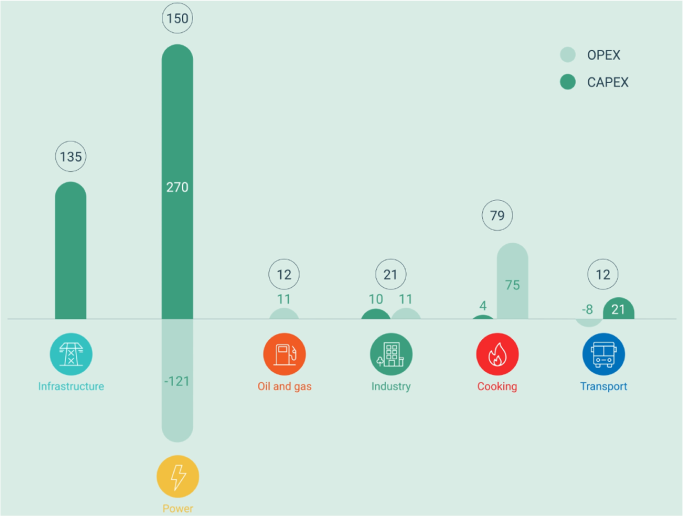
Emissions in this sector are largely driven by off-grid diesel/petrol generator use and on-grid gas combustion in power plants.
Due to insufficient generation and grid constraints, majority of households, businesses and industries in the nation generate their own electricity with diesel/petrol generators.
An urgent priority for decarbonization is the transition away from these diesel and petrol generators to cleaner sources of energy.
Due to insufficient generation and grid constraints, majority of households, businesses and industries in the nation generate their own electricity with diesel/petrol generators.
An urgent priority for decarbonization is the transition away from these diesel and petrol generators to cleaner sources of energy.

Oil and Gas
Emissions from the sector reduce primarily due to declining global demand. Residual emissions (post-demand reduction) of Oil and Gas extracting activities can be abated using levers such as:
Fugitives -
Instrument air systems, vapour recovery units on storage takes, replace compressor rod packaging and quarterly leak detection and repair
Fugitives -
Instrument air systems, vapour recovery units on storage takes, replace compressor rod packaging and quarterly leak detection and repair

Cooking
LPG plays a significant role up to 2030 due to urgency of the achievement of universal access to clean cooking (SDG7), the relevance of the fuel across household categories and Nigeria’s natural gas endowment. However, LPG is a stepping-stone in Nigeria’s Net Zero strategy.
Biogas and electric cookstoves are prioritized for deployment post 2030 since they are carbon neutral:
Electric cookstoves are used in grid-connected households
Biogas is available in rural areas which employ off-grid sources for primary electricity supply.
Biogas and electric cookstoves are prioritized for deployment post 2030 since they are carbon neutral:
Electric cookstoves are used in grid-connected households
Biogas is available in rural areas which employ off-grid sources for primary electricity supply.
transport
The ETP proposes the reduction of transport emissions by switching to low-emissions transport technology and mode-shifting. The focus of the ETP analysis is on passenger vehicles which accounted for ~72% of transport emissions in 2020.capacity)
Initial expansion of gas generation capacity to establish baseload capacity for meeting increased electricity demand and integrating renewables.
Ramp up of renewables-backed electrification to facilitate
decarbonization in sectors such as buildings (cooking),
industry and transportation.
Industry
Emissions in this sector are reduced through the substitution of clinker with calcined clay and application of Bioenergy with Carbon Capture and Storage (BECCS) in cement production, the replacement of grey hydrogen (Hydrogen produced from fossil fuels) with green and blue hydrogen in ammonia production, and the adoption of zero emissions fuels such as clean electricity and hydrogen for heating instead of natural gas and biomass.

Poverty reduction
Lifting 100 million Nigerians out of poverty and driving economic growth

Modern Energy access
Bringing modern energy services to the full population

legislation
Streamlining existing and new government related energy transition initiatives

job preservation
Managing the expected long-term job loss in the oil sector due to the reduced global fossil-fuel demand

Sustainable Transition
Playing a leadership role for Africa by promoting a fair, inclusive and equitable energy transition in Africa that will include Gas as a “transitionary fuel”